

The Architect of Dreams: How I Learned to Stop Writing and Start Building a Children's Book Empire
The Unlikely Blueprint for My First 5-Figure Month in Publishing.

Let’s be clear from the outset: I am not, by any traditional measure, a “creative.”
For years, I lived in the shadow of this self-imposed label. I’d watch with a mixture of awe and envy as authors, both traditional and self-published, spun worlds from mere words. The Amazon KDP revolution, particularly in the children’s book space, was a siren song I couldn’t answer. The business model was impeccable - print-on-demand, global reach, low overhead. It was a marketer’s dream. Yet, my forays into writing always ended the same way: me, a grown adult, staring at a cursor blinking on a blank page, trying to conjure the kind of magic that makes an eight-year-old’s eyes go wide with wonder. I failed. Every time.
My dream wasn’t to be a famous author; it was to be a builder, an architect of stories. I wanted to create a catalog, a body of work. But you can’t build a cathedral with a toothpick. My tools were inadequate. My imagination, I believed, was a barren field.
Then, I had a paradigm shift. What if I stopped trying to be the source of the water and instead learned to be the architect of the aqueducts? What if my role wasn’t to invent the spark of creativity, but to channel it, to structure it, and to build a system around it?
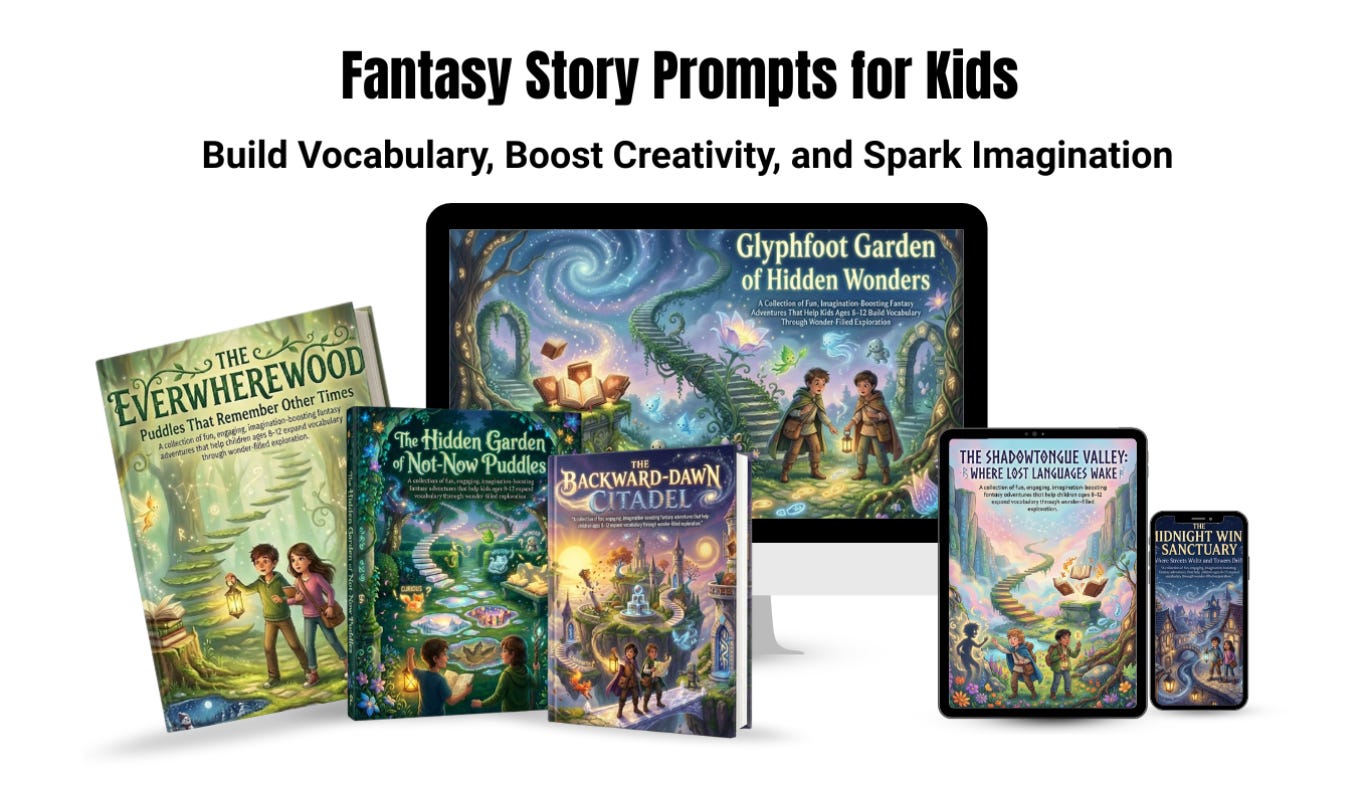
This is the story of how I found my aqueduct. It’s a review, yes, but it’s more accurately a case study on creative leverage. The catalyst for this change was a product called Fantasy Story Prompts for Kids (PLR).
The Breaking Point and the Leap of Faith
My breaking point came after my seventh attempt to outline a story about a dragon who was afraid of fire. It was pathetic. I was ready to relegate my publishing dreams to the “nice ideas I had once” folder.
In a final, desperate act, I purchased the Fantasy Story Prompts for Kids pack. My expectations were subterranean. I was prepared for a PDF filled with one-line suggestions like, “A boy finds a magic ring,” which would have been just another form of that dreaded blank page.
What I discovered, however, was not a list of ideas. It was a fully-operational creative foundry.
The product contains over 500 what I can only describe as “Narrative Architectures.” Each one is a comprehensive blueprint for an entire book. Let me show you what was inside a single blueprint, titled “The City Where Time Melted into Light”:
A Foundational Concept: This wasn’t just a title; it was a logline. It immediately established a unique, visual, and emotionally resonant premise.
A Publisher-Ready Description: Two paragraphs of beautifully crafted sales copy, written to appeal to both the child’s sense of wonder and the parent’s desire for educational value.
Strategic SEO Keywords: A list of 5 terms like “time travel book for kids” and “creative writing prompts,” pre-vetted for the Amazon KDP ecosystem.
An AI Cover Art Brief: A detailed, technical prompt for tools like Midjourney or DALL-E, specifying style (”whimsical watercolor,” “Pixar-esque 3D render”), composition, and mood.
The Engine Room: 10 Chapter Prompts: This was the masterstroke. Each prompt was a detailed instruction set, engineered to command an AI like ChatGPT to generate a complete, 1500-word chapter, complete with narrative arc, character development, and embedded vocabulary-building exercises.
This was not a pack of prompts. It was a system. And systems are something I, the “non-creative,” could understand and master.
The Genesis of a Library: A Week in the Life of a Creative Director
I decided to treat this as an experiment. I would dedicate one week to following the system with absolute fidelity.
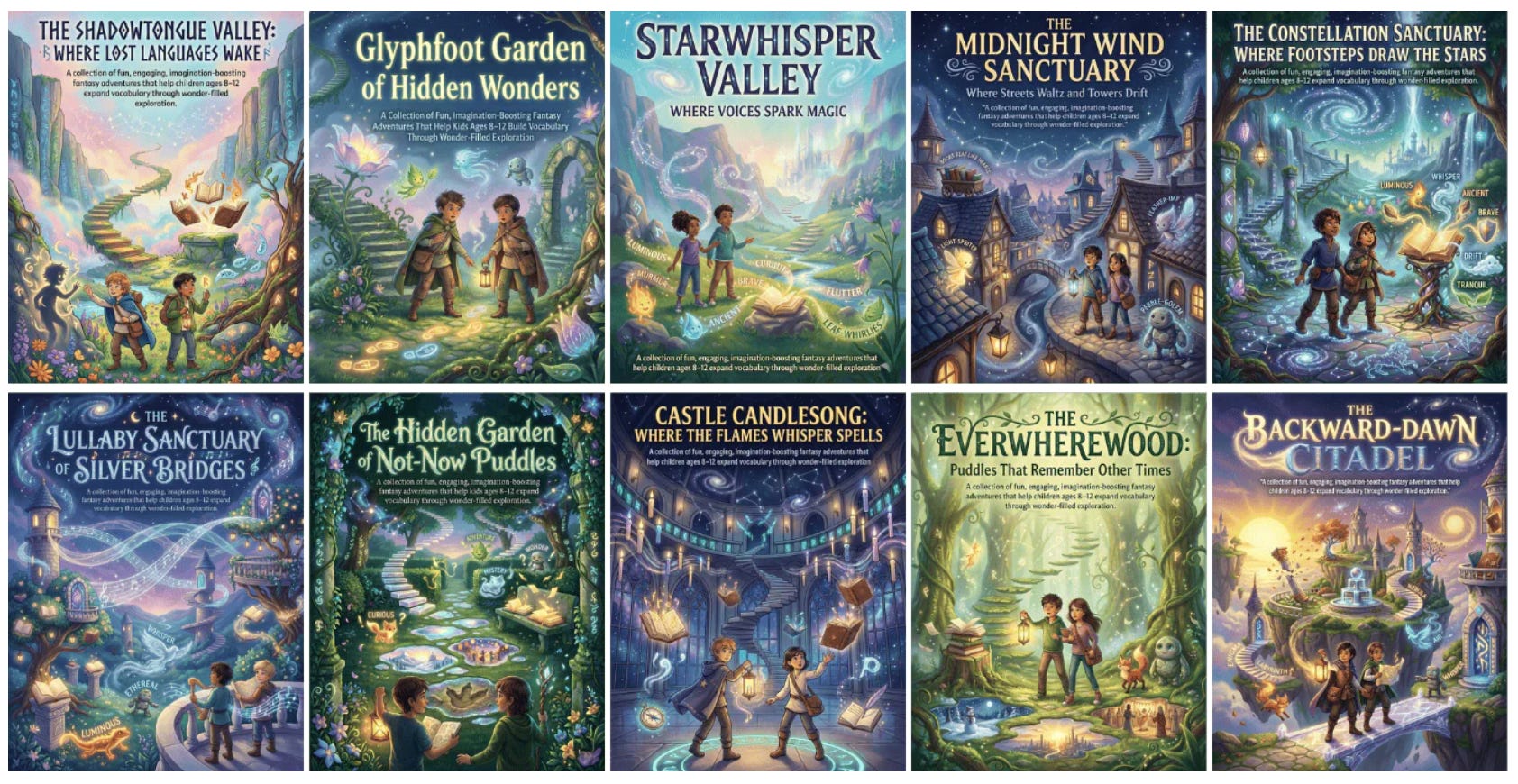
Day 1: The First Spark. I selected the “City Where Time Melted into Light” blueprint. With a deep breath, I copied the first chapter prompt into ChatGPT. The response was… staggering. It wasn’t just a block of text. It was a chapter. It opened with a cinematic description of a city made of crystalline light, introduced a relatable young protagonist, and set up a central mystery. It was layered, imaginative, and structurally sound. In 60 seconds, it had achieved what I couldn’t in months.
Days 2-4: Building the Skeleton. Each subsequent chapter prompt built on the last. The AI, guided by this intricate scaffolding, maintained consistent character voices and advanced the plot logically. I wasn’t just collecting random text; I was assembling a pre-designed narrative. My role shifted from frustrated writer to attentive editor and curator. I would lightly tweak a line of dialogue, ensure a character’s motivation was clear, and marvel at the complex themes of memory and impermanence that were emerging—themes I never would have conceived on my own.
Day 5: Giving it a Face. I took the cover art prompt and fed it into Midjourney. After a few iterations, I had a stunning, professional-grade book cover featuring a child reaching out to touch a clocktower that dissolved into a cascade of liquid light. It was perfect. It looked like it belonged in a bookstore.
Days 6-7: The Birth of an Empire. With one book complete, I saw the bigger picture. I browsed the other 499 blueprints and found four with complementary themes: a “Whispering Woods,” a “Library of Lost Memories,” a “Sea of Singing Clouds,” and a “Valley of Echoing Shadows.” I realized I wasn’t just building a book; I was building a universe. By the end of the week, I had outlines and initial chapters for all five books. I had transitioned from a stymied individual to a productive creative director overseeing a multi-project studio.
The Deeper Magic: Why This System is a Strategic Masterpiece
Beyond the obvious time-saving (I conservatively reclaimed 20+ hours that first week), this product offers a profound strategic advantage for any entrepreneur, especially on a platform like Substack where we understand the value of niche expertise and systematic creation.
It Solves the Scalability Problem. Any creator can have one good idea. The challenge is the second, the tenth, the fiftieth. This system turns creativity from a finite resource into a renewable one. It allows you to scale your imagination on demand.
It Provides Quality Control at the Source. The prompts aren’t generic. They are meticulously crafted to produce stories that are not only engaging but also educational. They naturally weave in vocabulary building, emotional intelligence, and creative thinking exercises. This ensures a consistent, high-quality product that earns 5-star reviews and repeat customers.
The PLR License is Your Sovereign Grant. This is the most critical element. The Private Label Rights license isn’t just a permission slip; it’s a deed to your own creative land. The stories you generate are your intellectual property. You can:
Publish them on Amazon KDP.
Create accompanying workbooks and sell them on Etsy.
Serialize the stories for a paid Substack newsletter for parents and educators.
Bundle them into a premium course on creative writing for kids.
You are not just a user of the system; you are the owner of the assets it produces.
If you’ve ever felt the entrepreneurial itch to create but lacked the “how,” this is the missing piece of your puzzle.
The Honest Constraints: You Are Still the Master Builder
This is not a magic wand. It is the most powerful chisel you will ever own, but you must still be the sculptor. The system requires you to be the project manager. You will:
Curate and Refine: The AI generates a diamond in the rough. Your human sensibilities are required to polish it, ensuring voice consistency and emotional resonance.
Oversee Production: You are in charge of the entire pipeline, from prompt to published book.
Embrace the Market: A beautiful book must find its audience. The system gives you the SEO keywords and a great description, but understanding Amazon’s algorithms and basic marketing principles is still part of the journey.
This product doesn’t replace the creator; it empowers a new kind of creator—the visionary who builds worlds, not just with a pen, but with a process.
The Final Blueprint: My Verdict
Fantasy Story Prompts for Kids (PLR) did more than just help me write books. It redefined my relationship with creativity. It allowed me to step into the role I was always meant to occupy: the architect, the creative director, the builder.
For the Substack community - a collective of thinkers, writers, and niche experts - this tool is a force multiplier. It’s for the historian who wants to make the past exciting for children, the scientist who wants to explain quantum physics through fantasy, or the marketer who sees an opportunity and needs the content to seize it.
It is the ultimate antidote to the tyranny of the blank page. It is a declaration that your lack of a traditional “creative” bone in your body is no longer a valid excuse. The system is here. The blueprints are drawn. The only question that remains is whether you will pick them up and start building.
The most beautiful libraries in the world weren’t built by people who merely loved books. They were built by architects who knew how to structure the space to hold them. What will you build to hold your stories?